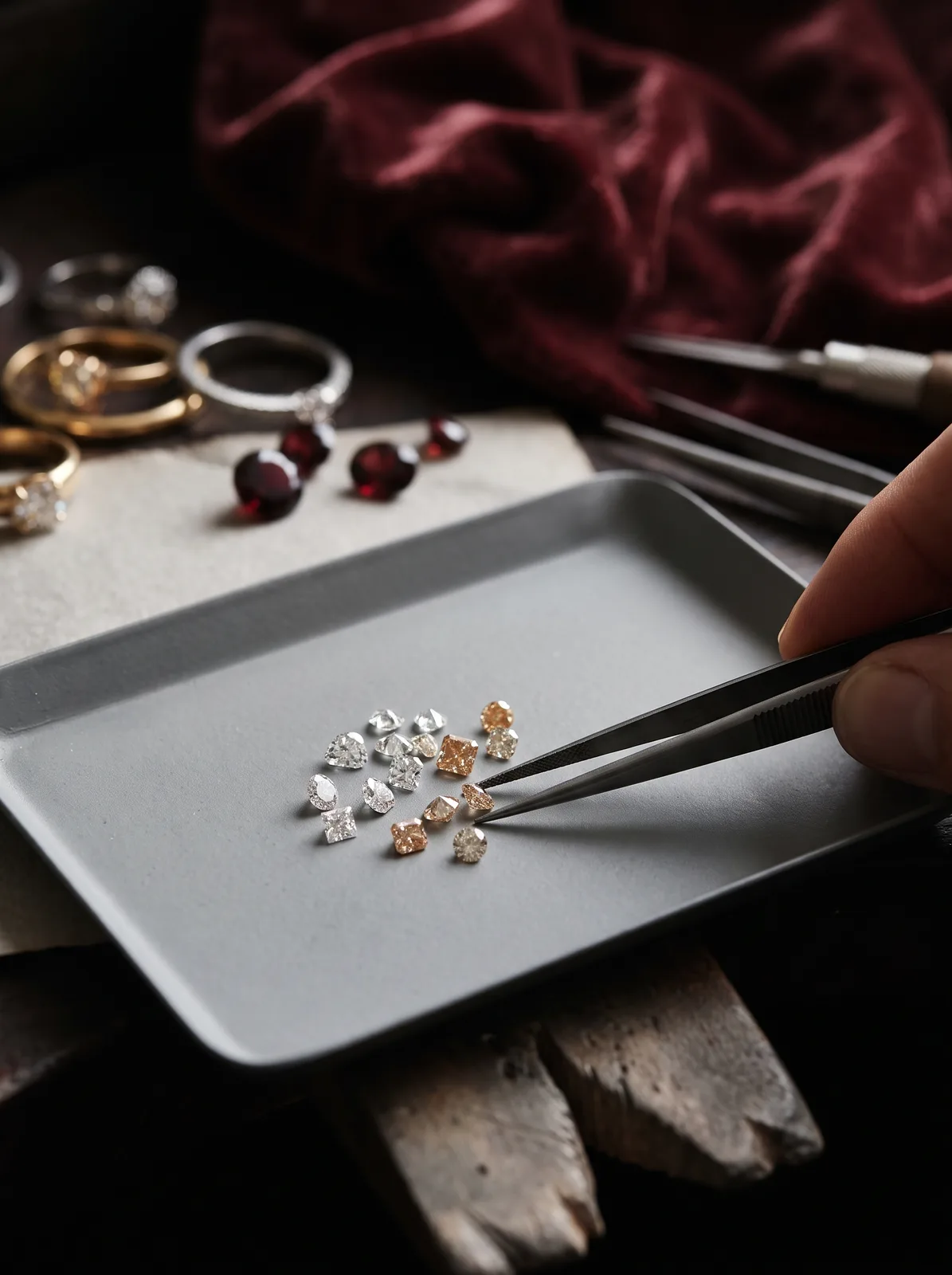
Most people arrive having read about the four Cs and leave having chosen with their eyes. Both matter. Here is how I explain them when we sit down with a tray.
Cut is the one to spend on
Cut decides how a diamond handles light. A well-cut stone looks bright from across a room and lively up close; a poorly cut one looks glassy however large it is. For round stones there is a grade to guide you. For ovals, cushions and emerald cuts, there isn’t, which is why we look at them together in daylight before anything else.
Colour and clarity, in proportion
- Colour runs from D (no colour) downwards. In yellow or rose gold, a G or H looks just as white once set, and costs noticeably less.
- Clarity describes tiny inclusions. From VS2 upwards, you won’t see them without a loupe.
- Champagne diamonds are a natural colour, not a lower grade. They suit warm gold and cost less than white stones of the same size.
Carat is size, not quality
Two stones of the same weight can look quite different in size, depending on how they were cut. An oval of 0.9 ct can look as large as a round of 1.1 ct. We show you stones by how they look on the hand, not by the number on the report.
Choose the stone that makes you look twice. Then check the report.
Sapphires and spinels
For a coloured engagement ring, sapphire is hard enough for daily wear and comes in more colours than blue. Spinel is a little softer and often brighter. Both are traced to the mine in the same way as our diamonds.
Every diamond of 0.5 ct or more comes with an independent grading report, and every stone we sell can be traced to its mine and cutter. If you’d like to see a selection, tell us your rough budget when you book and I’ll prepare a tray.